Showing posts with label publications. Show all posts

Thursday, January 26, 2017

ePortfolio Hub from Ireland

eportfoliohub logo
I just received notice today about a new website in Ireland, which is part of a national program in ePortfolio development in that country.  According to their announcement:
As part of a National-Forum funded project, Dublin Institute of Technology, Institute of Technology Tallaght, Institute of Technology Blanchardstown and Hibernia College are delighted to launch the ePortfolio Hub website, which offers a one-stop-shop for anyone interested in incorporating ePortfolios into their teaching or creating their own ePortfolio, including how-tos, templates, guides, presentations, videos and research findings. 
I participated in a conference last March in Dublin, and I recognize a lot of ideas from my keynote address, which I organized around these three questions:
The website contains a lot of videos and resources to either create a personal portfolio, or incorporate an ePortfolio into an academic program. 
The largest section of the website focuses on the How of creating ePortfolios, focusing on four steps (for individuals) or three steps (for programs):
The Plan section has great resources that provide checklists and resources that are similar to the Planning resource that I have incorporated into my online course. The Reflect section has an insightful video on Reflective Writing, and a very interesting page on Reflective Practice using Barbara Bassot’s ‘Metaphorical Mirrors’. The Present section includes videos on developing digital identity. The Assess section (for programs) includes a variety of sample rubrics for evaluating ePortfolios. There are also sample portfolios, samples of reflective writing, description of the variety of online tools available, and video tutorials for developing an ePortfolio using WordPress.

Overall, this is a great resource for higher education, with a lot of local videos from students and faculty to support the elements of ePortfolio development. I am impressed and proud to have been a small part of the process, beginning with the conference last March.


Tuesday, January 17, 2012

Technology & Learning Question of the Week

Today, the Question of the Week on the Technology & Learning newsletter was:

Is your district using e-portfolios to evaluate student work?
  • YES. These are great tools for assessing students and building individual portfolios.
  • NO. E-portfolios are too hard to manage. 
  • LOOKING INTO IT. Our school is evaluating the logistics of implementing these assessment tools. 
I find the statements following each response to represent a biased and narrow perception of the use of e-portfolios (for evaluation), but there is no way to add a comment or provide feedback on the survey itself. No wonder we have limited adoption of e-portfolios with this lack of understanding about the genre. E-portfolios are not just tools; they are a philosophy and a process to support learning!

Friday, June 17, 2011

Links to recent E-Portfolio articles and blog posts

I've come across some recent articles and blog posts that provide interesting reading about e-portfolios.
  • E-Portfolios Evolve Thanks to Web 2.0 Tools in EdWeek, June 15, 2011.  I am quoted in the article and I previously blogged about my visit to Rob Van Nood's classroom, the first example (I made the connection between him and the author). Here is my comment on the EdWeek article:
    Thanks for the examples, including Rob's classroom, which was a fun place to visit. The need for teacher professional development is important to meet the potential of e-portfolios to engage students in managing their own learning. That is why next week at the ISTE Conference, I am launching the REAL* ePortfolio Academy for K-12 Teachers (*REAL = Reflection, Engagement, Assessment for Learning).  Primarily through online courses which establish grade-alike Communities of Practice, K-12 teachers from across the world will learn portfolio development principles, share strategies, and support each other in implementing e-portfolios using free Web 2.0 tools.
    Dr. Helen Barrett http://electronicportfolios.org/academy/
  • Nick Rate's recent blog post, ePortfolios in the News,  has links to some new websites. Two I particularly like:
    Eportfolios - J'accuse where the author discusses the benefits of using a blog as an e-portfolio over specialized e-portfolio systems: Over-complication; Institutional, not user focus; Focus on the tool, not the skills; Lack of social element; Educational arrogance.

    E-portfolios – 7 reasons why I don’t want my life in a shoebox:  Uninteroperable; Institutionalised; Human nature; People are not learners [I disagree!]; Boundary problems; Plus ca change [the only constant is change]; Recruitment myth. I agree with some of his comments, but I think he misses the potential in others. The author, Donald Clark will be a presenter at the EIFEL Conference in July in London. I think I will be leading the panel.

    The comments on both of these blogs are great reading!
  • Blogs as Showcase Portfolio by Kim Cofino, June 12, 2011. This is a GREAT resource (she uses WordPressMU with her 6th grade students... see examples). I love Clint Hamada's comment on this post, partially copied here:
    Kim, thanks for highlighting the ease of using blogs as a portfolio tool. The key, I believe, is to create a culture of blogging (and sharing and reflecting) as part of the day-to-day workings of the school. Then the showcase is truly that: a showcase of things students have already done that do not require any huge amounts of work to prepare!
    My response: I love this post and Clint's follow-up comment. The first level of building an electronic portfolio is to capture and save work in digital form (integrate technology into the teaching/learning process); the second level is to set goals and reflect frequently (a blog is the perfect environment for connecting artifacts and reflection); the third level is building a showcase portfolio at specific times during the school year (parent conferences? formal presentations of learning?). I discuss this process in more detail in my online article, Balancing the Two Faces of ePortfolios (2011, British Columbia Ministry of Education, Innovations in Education, 2nd Edition). I’ll be sharing your links! Thanks!
There is a theme in these blog posts, and in my recent research for my book: blogs are a great tool for developing e-portfolios, from Kindergarten through adulthood. People have been keeping written journals for centuries; blogs provide a similar space for reflection and deep learning, with a significant difference in storage and permanence. (I once blogged about the loss of physical memories through natural disasters, such as floods or fire: Digital Archive for Life, 2005) As long as Blogger keeps it stored digitally, it should last my lifetime and beyond (I've misplaced a lot of paper journals over the years). But every so often, I back it up... JUST IN CASE!

I've created many versions of my thematically-organized presentation portfolio, but I rarely visit or update these showcase portfolios (the only one I keep updated is my GoogleSites URL-branded version, first developed in 2008). My reflections are posted in this blog, which I consider my learning portfolio... and the easiest and most natural to maintain as a learning journal. The structure of a blog also lends itself well to comments and conversation.

Sunday, January 09, 2011

Russian (and German) version of Balancing diagram

I received a Russian translated version of my Balancing the Two Faces of Electronic Portfolios diagram. This addition makes fives different translations: Spanish, Catalan, Japanese, Mandarin, and now Russian. As this EFL Instructor fron Volgograd State University said, when she sent me the image,
Your works have helped me greatly and I translated the table about two sides of e-portfolio into Russian during my work. It is one of our main fields of work to localize foreign literature for Russian public and vice versa. As I saw some foreign versions of your table in the online publication of the article such as Mandarin and Spanish I thought probably it will be a good idea to place the Russian version as well. So to express my gratitude I decided to send you the result of my work and hope it may become as useful for you as your works have become to me.
Thanks! These translated versions provide visual representations of how this concept has been accepted across the world!
UPDATE 1/26/11: I received the following message today: "attached I send you the German translation of your slide that is very helpfull for understanding the idea of eportfolios." This version is also included after the others on the web page.

Wednesday, October 20, 2010

ePortfolios for Managing Oneself and Portfolio Careers

On Monday and Tuesday, I attended a Conference on Advising Highly Talented Undergraduates, held at Notre Dame University. On the first day, Dr. Richard Light of Harvard University provided the opening keynote address on the Challenges for Advising Highly Talented Undergraduates. He mentioned an article by Peter Drucker entitled, "Managing Oneself" published in the Harvard Business Review in 1999. I found several copies of the article through an iPhone Google search, and downloaded it. The purpose for the article struck a cord with me:
“Success in the knowledge economy comes to those who know themselves
– their strengths, their values, and how best they perform.”
We live in an age of unprecedented opportunity: If you've got ambition and smarts, you can rise to the top of your chosen profession, regardless of where you started out. 
But with opportunity comes responsibility. Companies today aren't managing their employees' careers; knowledge workers must, effectively, be their own chief executive officers. It's up to you to carve out your place, to know when to change course, and to keep yourself engaged and productive during a work life that may span some 50 years. To do those things well, you'll need to cultivate a deep understanding of yourself-- not only what your strengths and weaknesses are but also how you learn, how you work with others, what your values are, and where you can make the greatest contribution. Because only when you operate from strengths can you achieve true excellence.
Here is where an ePortfolio can provide an ongoing environment where individuals can develop and manage their own personal SWOT analysis (Strengths, Weaknesses, Opportunities, Threats). The article contains the following sections:
  • What are my strengths?
  • How do I perform?
  • What are my values?
  • Where do I belong?
  • What should I contribute?
  • Responsibility for Relationships
  • The Second Half of your Life
I can see a powerful purpose for ePortfolios: managing knowledge workers' career development, from high school through late career. There is another opportunity: managing "portfolio careers." As I was preparing for my closing keynote at this conference, I explored websites that focused on Portfolio Careers:
I also found this video that encapsulated some of the key elements of portfolio careers:
Next Generation Journalist: Nick Williams from Adam Westbrook on Vimeo.

"Today, security means being employable, even if you don't have a job." The speaker talks about the concept of personal branding: "everyone needs to know what they are uniquely brilliant at… what they're passionate about, what they love doing, and what they're good at doing, and then finding people who want to hire them at that.

Slides for my keynote presentation are posted on Slideshare.

Thursday, October 07, 2010

New ePortfolio online publications

I have been collecting some new articles on ePortfolios in my delicious.com account. Here are some of the most interesting:
  • The Complexity of Implementing e-Portfolios
    Lisa Gray (JISC) and Gordon Joyes (University of Nottingham) spoke about the complexities involved in implementing e-portfolios and the concepts that need to be understood to achieve a successful implementation. A model for e-portfolio implementation built around threshold concepts, misconceptions and pre-conceptions: The roles of Purpose, Learning Activity Design, Process, Ownership, and the Transformative and Disruptive nature of e-portfolios. Includes links to video of presentation at the Mahara UK 2010 conference.
  • Effective practice with e-portfolios: How can the UK experience inform practice? (PDF) Speaking of the Disruptive Nature of ePortfolios, this paper documents research by Gordon Joyes, Lisa Gray, and Elizabeth Hartnell-Young (Victoria Department of Education and Early Childhood Development, Australia). This paper introduces the background to the JISC work within the e-portfolio domain in the UK and presents an overview of past and current activities and the drivers for these developments. This is followed by a review of JISC’s approach at drawing out the learning and implications for e-portfolio practice from this extensive collection of work and its dissemination. The analysis of twenty one recently funded projects involving the use of e-portfolios in the UK is introduced. The findings suggest that e- portfolio implementation is particularly complex in part due to the number of stakeholders involved, the contexts in which e-portfolios can be applied and the number of purposes they can have. This research suggests that there are threshold concepts related to e-portfolio implementation and that the journey in developing an understanding of effective practice is not straightforward. However a means of supporting this journey is suggested.
  • The Accountability/Improvement Paradox- from Inside Higher Ed - "there is an inherent paradox in the relationship between assessment for accountability and for improvement."
I also found some interesting websites about K-12 ePortfolios:

Sunday, June 06, 2010

Japanese & Portuguese version

I just received a copy of the Japanese translation of my Balancing the Two Faces of ePortfolios diagram.
Translated by Junko NEMOTO, PhD, Kumamoto University, Japan, who told me:
It helped us when we talked and decided our portfolio concept.
I also would like to use sometime to explain the portfolio to the students.
That makes three translations: Spanish, Catalan, and now Japanese. This conceptual model seems to make sense in multiple contexts.

The paper was just published (in English) in a Portuguese Educom journal in PDF.

UPDATE: Now I have a Mandarin version of the diagram, thanks to Andy Birch and Mei Ding, Hong Kong Academy.

Tuesday, December 15, 2009

Assessment, Accountability and Improvement - a paper by Peter Ewell

National Institute for Learning Outcomes Assessment (NILOA) has published an occasional paper by Peter Ewell. I read an earlier version when I was at the Assessment Conference in Indianapolis in October, when I attended several sessions where Dr. Ewell discussed some of these ideas. The table below outlines two paradigms of assessment that represents two extremes along a continuum that represent tensions between improvement and accountability.

Assessment Portfolios are implemented somewhere along the continuum between those two paradigms. As I emphasized in an earlier blog entry,  the concept of Opportunity Cost should be considered here (what do we give up when we emphasize accountability or improvement based on these two paradigms of assessment?). How can we find a balance along the continuum between these two approaches? Here are some preliminary ideas for addressing the balance issues:

Tools
  • Use separate tools for assessment management and student e-portfolios?
    (Ball State’s rGrade & WSU’s Harvesting Gradebook)
  • Incorporate blogging and social networking tools for interactivity and engagement
    (Open Source Tools:  WordPress, Movable Type, Mahara)
  • Allow embedding student Web 2.0 links, including video, into their e-portfolios
  • Enable exporting e-portfolio to students’ lifetime personal webspace
Strategies
  • Acknowledge the importance of both portfolio as workspace (process) & showcase (product)
  • Support student choice and voice in e-portfolios
  • Facilitate reflection for deep learning
  • Provide timely and effective feedback for improvement
  • Encourage student use of multimedia in portfolios for visual communication and literacy
    • Digital Storytelling & Podcasting
    • Picasa/Flickr slideshows
  • Acknowledge/Encourage students’ Web 2.0 digital identity

Thursday, December 03, 2009

T.H.E. Article on E-Portfolios

This article, published by T.H.E. Journal provides a shallow overview of e-portfolios in K-12 schools, mostly providing an incomplete look at the types of tools available. The author also made the following statement:
Google is probably the leading provider of mashup services and software for the creation of e-portfolios. The search giant isn't yet offering an e-portfolio product, per se, but in 2007 it began publishing a step-by-step process for combining its Google Apps software into e-portfolio mashups. On its "Google Apps E-Portfolios Mashup" web page, the company has published a series of documents describing how to mash up such applications as Google Docs, Gmail, Google Notebook, Blogger, and the iGoogle portal to, essentially, create an e-portfolio.
Google is also providing guidance specifically aimed at K-12 education. The company has published descriptions of three levels of K-12 e-portfolios: e-portfolio as storage; e-portfolio as workspace; and e-portfolio as showcase.
Lowendahl [Garner Group] is pleased to see Google getting into the e-portfolio business. He says interest from companies of such stature is necessary to secure the application's future.
I agree, it would be nice if Google was getting into the e-portfolio business, but they aren't. What the author is referencing is MY website. Here is the comment that I added to the article:
 This article provides interesting information about e-portfolios, although some of it is inaccurate and incomplete. It is true that most of the research and implementation of electronic portfolios has been in higher education. My reading of the Gartner Hype Cycle for Education, 2009, noted that ePortfolios were listed in the stage of "Sliding Into the Trough" (...of Disillusionment). To move to the next stage of the cycle (Climbing the Slope... of Enlightenment) we will need to have more research on the most appropriate strategies and "best practices" to support student learning, especially at the K-12 level.
Your reference to Google's support of ePortfolios was actually posted on MY website (http://electronicportfolios.org/google/ ). I wrote the K-12 support materials for both GoogleApps (and WordPress), linked from my web page (http://electronicportfolios.org/ and published using Google Sites). I developed the three-level model, based on my collaboration with both Washington State University and several school districts in California and Texas:
1. portfolio as storage (collection of artifacts)
2. portfolio as workspace (collection plus reflection/metacognition)
3. portfolio as showcase (selection, summative reflection and presentation)
It is also important to recognize that reflection is the "heart and soul" of a portfolio... not the technology or collection of artifacts. The real value of an e-portfolio is in the reflection and learning that is documented therein, not just the collection of work.
My note to the author: To whom at Google do I send the bill for all my development work over the last two years? ;-)

UPDATE: After having a nice conversation with the author, the online article was corrected to read:
Google is probably the leading provider of mashup services and software for the creation of e-portfolios. The search giant isn't yet offering an e-portfolio product, per se, but in 2007 educator Helen Barrett, who has been researching strategies and technologies for e-portfolios since 1991, began publishing a step-by-step process for combining Google Apps software into e-portfolio mashups. On her "Google Apps E-Portfolios Mashup" web page, she describes how to join such applications as Google Docs, Gmail, Google Notebook, Blogger, and the iGoogle portal to create an e-portfolio.
Barrett also provides guidance specifically aimed at K-12 education. She has published descriptions of three levels of K-12 e-portfolios: e-portfolio as storage; e-portfolio as workspace; and e-portfolio as showcase.

Friday, November 06, 2009

CIC Website: Teachers for the 21st Century


I have been working on this new website for the last five months, and it will be announced and showcased at The Council of Independent Colleges annual Institute for Chief Academic Officers, to be held in Santa Fe on November 7-10, 2009. The website includes the ten webinars that I did for CIC under a Partners in Education program funded by Microsoft (seven on electronic portfolios, three on digital storytelling). I also helped the faculty members develop the digital stories that are embedded in this site.  I learned a lot about converting WMV-to-Flash video and discovered Motionbox as a website to store videos online. I also published a simplified version of the content on my website.

Tuesday, November 03, 2009

[Portfolios] Here, There, & Everywhere

Campus Technology just published another article about ePortfolios (where I am quoted extensively). I'm not sure if she quoted my blog, or the ePortfolio Track keynote that I did last week, when I said I thought that universities should be getting out of the portfolio storage business, giving students control of their own web space to store their portfolio documents, using Web 2.0-based storage systems. My response to the article:
Thanks for quoting some of my work. There are some standards under development in the U.K. (LEAP2A) which resemble blogging standards for interoperability. There is a student side and an institution side to the e-portfolio process. The student side is the Personal Learning Environment (as indicated in the article); the institution side is more of an assessment management system. We need to be careful that the standards don't over-structure the PLE side of the e-portfolio so that personalization and creativity are diminished... that is the situation today with most of the commercial and open source e-portfolio tools. The article didn't mention WSU's Harvesting Gradebook which keeps track of assessment data, letting the student use a variety of Web 2.0-based portfolio artifacts. We need more R&D on better tools that keep the portfolio development and assessment processes distinct but interconnected. At the Assessment Institute in Indianapolis last week, I proposed that there is an Opportunity Cost in the way we implement portfolios for accountability vs. portfolios for learning/improvement. Student engagement supporting lifelong learning strategies should be as important as collecting data for accreditation. Finding balance in the process is the challenge.
 The article mentions the Gartner Hype Cycle for Education, 2009, and ePortfolios were listed in the stage of "Sliding Into the Trough" (...of disillusionment, where we say "woah, we were sold down the river"). To move to the next stage of the cycle (Climbing the Slope... of Enlightenment, where we say, "no, come to think of it, used in the right way, this can be good") will be a challenge: figuring out "the right way" from which philosophical perspective? Accountability or Learning/Improvement?

Monday, November 02, 2009

E-portfolios in formative & summative assessment in UK

The final report, plus case studies (34 in total) from the "Study on the role of e-portfolios in formative and summative assessment practices" by a team led by the Centre of Recording Achievement (U.K.), are now available from JISC:
http://www.jisc.ac.uk/whatwedo/programmes/elearning/eportfolios/studyontheroleofeportfolios.aspx
Interesting reading from higher education in U.K.

Tuesday, September 22, 2009

Official Google Docs Blog entry

I just wrote a guest blog entry on the Official Google Docs Blog on Electronic Portfolios in GoogleApps. It was an interesting process... trying to compress my thoughts into 500 words! But we used a shared Google Doc document that currently has 597 revisions! It was fun to edit a document with someone who really understands the collaborative editing capabilities of Google Docs.

Also made it on the Google Student blog as Creating your digital resume. I've been given a lot of titles (ePortfolio guru, the grandmother of ePortfolios) but on Twitter today there was a first: ePortfolio jedi master!

Another 15 minutes of fame on the Internet! And another public mention of writing a book... I guess I need to get it written!

Monday, August 31, 2009

New Google Sites

I worked on developing two new Google Sites this weekend to support ePortfolio development in both K-12 schools and in higher education:
  • GoogleApps ePortfolios - a resource on using Google Apps for Education (and specifically Google Sites) to develop and maintain ePortfolios
  • WordPress E-Portfolios - resource on using WordPress or Edublogs to develop and maintain ePortfolios
I am inviting other educators with experience using these tools to participate in developing these two sites. I intend to use these sites as part of the research for my book, also inviting teachers who want to implement ePortfolios with Web 2.0 tools to participate in the research. I will be formulating a plan which will be announced right after Labor Day.

Wednesday, July 15, 2009

ePortfolios - Celebrating Learning (in NZ)

The New Zealand Ministry of Education has just posted a report that discusses these questions:
  1. What are the important features of a platform to support ePortfolios for NZ education?
  2. Is it possible for one system to accommodate the entire spectrum of requirements across the education sector?
  3. How important is interoperability of ePortfolio data?
  4. What are the key criteria for selecting a system?
This report was written by Ian Fox, Sandy Britain and Viv Hall, and provides a good discussion of the issues of implementing ePortfolios across the K-12 age span. I was impressed by the five case studies included in the Appendix, as well as a brief comparison of the two ePortfolio technical standards: the IMS ePortfolio specification and LEAP2A, developed by CETIS in the U.K. (hint: the report recommended adoption of the LEAP2A standard).

At NECC, I heard a rumor that ePortfolios were proposed as part of the National Educational Technology Plan. After reading this report, I am wondering whether individual states and/or the U.S. Department of Education would consider the ideas presented in this study. I am always so impressed with the implementation of ePortfolios in New Zealand, and I've blogged about them frequently. I am trying to figure out how to get down there in February or March 2010, when I am also going to conferences in India and possibly Singapore. A visit to NZ will wrap up the research for my book!

Thursday, May 28, 2009

Wordle of this blog

Just for fun, I've been taking some of my digital documents and putting them through wordle.net. The Wordle above is for this blog before today... sort of looks like a footprint. Hmmm... It is fun to see the themes that come through the most-used words in a document. Below is the Wordle for my latest article, Balancing the Two Faces of ePortfolios:
An interesting way to learn from a word cloud! Almost better than an abstract!

Sunday, May 17, 2009

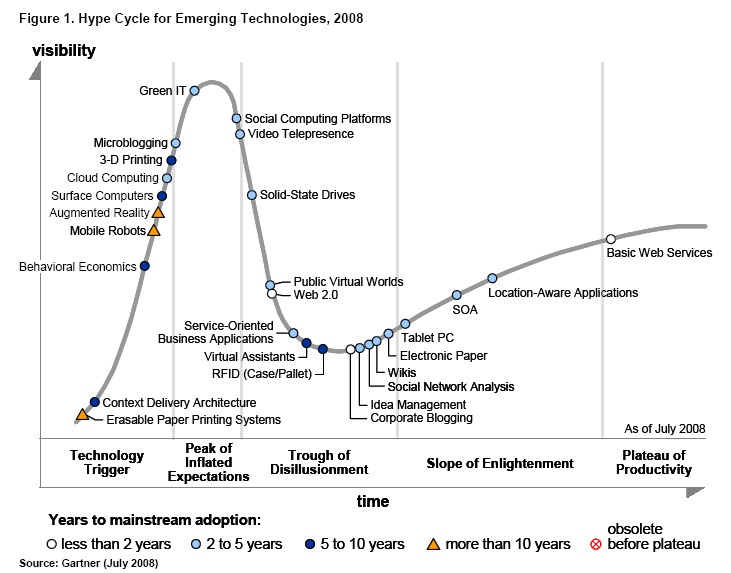
Technology Trends and Gartner's Hype Cycle


I found this diagram of Gartner's hype cycle in a blog entry about cloud computing and the Tech Crunch blog.
Essentially, industries, companies and people go through the 5 stages of: 1) heh, this is cool, 2) yeah, we all think this cool, 3) woah, we were sold down the river, 4) no, come to think of it, used in the right way, this can be good and finally 5) this has become part of what we do." (Source: Buzz Canuck)
Where are ePortfolios along this continuum? I think Higher Ed is generally in stages 2 and 3... what needs to help move into stages 4 and 5? In my opinion, K-12 is just entering the cycle. I found a couple of online publications by the New Media Centers Consortium that outline emerging technologies:
It is interesting to note that the NMC sees K-12 following higher education in some technologies that I think are going to have a big impact on ePortfolios: Cloud Computing and The Personal Web. It is encouraging that Collaborative Environments and Online Communication Tools are imminent adoptions in K-12 (already adopted in higher education), and I believe both of these technologies are essential to an ePortfolio 2.0 environment.

Friday, May 01, 2009

ePortfolio Surveys

I am developing a new Google Site to collect surveys on Electronic Portfolios. I invite others to share surveys that they have used for different purposes within the context of Electronic Portfolio Development.

Sunday, March 15, 2009

More Interesting Reading

Some new online articles and an updated version of a book:
  • Randy Bass and Bret Eynon: Still Moving From Teaching to Learning (in the Wired Campus blog) referencing the January 2009 issue of Academic Commons. I find the comments even more illuminating, providing provocative comments from some more traditional academics.
  • Electronic Portfolios: a Path to the Future of Learning (in the Chronicle of Higher Education, Marh 18, 2009) also by Randy Bass and Bret Eynon. This blog entry provides a short summary of several success stories about e-portfolios, summarizing four fundamental features:
    • First, ePortfolios can integrate student learning in an expanded range of media, literacies, and viable intellectual work.
    • Second, ePortfolios enable students to link together diverse parts of their learning including the formal and informal curriculum.
    • Third, ePortfolios engage students with their learning.
    • Fourth, ePortfolios offer colleges a meaningful mechanism for accessing and organizing the evidence of student learning. In many ways, ePortoflios are not primarily about technology but a commitment to a set of principles about education.
  • Standards to Take ePortfolios Outside the Institution and into the Future, a conversation with Phil Ice about ePortfolio standards in Campus Technology, where he focuses on the use of the new Adobe Acrobat 9 to keep ePortfolio data accessible over time (something I discussed in the 90s... but now I think ePortfolios published in compliance with WWW technical standards would be just as accessible in the foreseeable future).
  • ePortfolio: There's No 'There' There, a Viewpoint by Trent Batson in Campus Technology about how "ePortfolios mean differing things to different people."
    For some, an ePortfolio is an open education approach to learning. For others, it's the technologies that support open education. For others, it's the learning artifacts students create and structure. For still others, it's a way to assess student progress toward learning goals. And, finally, for others, ePortfolios are a way to record a person's professional achievements over time.
    Again, the Comments are even more interesting.
  • Google Apps Eportfolio Online Rubric and Assessment Form providing an Evaluation Rubric for ePortfolio (I think this focuses on K-12).
I also received the Second Edition of The Learning Portfolio: Reflective Practice for Improving Student Learning, edited by John Zubizarreta. The new version of this book, part of the Jossey-Bass Higher and Adult Education Series, provides 14 articles under a section entitled, "Models of Learning Portfolios" and both Sample Learning Portfolio Selections and a large section of Practical Materials, including portfolio assignments and rubrics. The author made a slight change to his graphic model of a learning portfolio, which illustrates the following equation: Reflection + Documentation/Evidence + Collaboration/Mentoring = Learning. It is at the intersection of these three elements that you will find a Learning Portfolio.

Wednesday, February 04, 2009

Feedback on Diagram

I posted the diagram in my last post to my Google Group "Researching Lifelong Portfolios and Web 2.0" and received some great feedback on it. So I updated it on the list. Today, I received a Spanish version of the diagram in my email from a teacher educator in Madrid! I love Web 2.0!

As I said in one of my posts in that discussion, "This is an example of how a social network can provoke critical thinking! I have modified the diagram, because I recognize that the process is not always linear. However, when a novice begins the process of building toward some type of presentation portfolio (the "product" or showcase in this diagram), it helps to have a sequence of tasks to complete. So I took the comments into consideration as I revised the diagram..."